Waste heat in data centers: A valuable contribution to greater energy efficiency and sustainability



Servers and IT components in data centers, for example, generate heat during normal operations. This waste heat can potentially be repurposed to supply surrounding households and businesses with heating and hot water or fed directly into district heating networks. By recovering and reusing waste heat, we can reduce the consumption of fossil fuels that could otherwise be needed for heat generation—cutting carbon dioxide (CO₂) emissions and increasing overall energy efficiency.
Sustainability and active participation in the clean energy transition have long been central to our corporate strategy. We’re reinforcing that commitment with two waste heat projects in Frankfurt: at Digital Park Fechenheim and Digital Park Ostend. With these initiatives, we are proactively advancing waste heat utilization.
Our project at Digital Park Fechenheim
Expected to begin in early 2027, approximately 30,000 square meters of space belonging to real estate company OSWE—including the natural wood furniture store “Möbelum”—will be heated using waste heat from our Digital Park Fechenheim.
Project details
As part of the project, waste heat from our data center is raised to the temperature level required for heating office and storage facilities through the use of heat pumps. This process transforms heat that would otherwise go unused into a practical energy resource. The electricity needed to power the heat pumps and auxiliary units will be sourced from renewable energies, ensuring the buildings are heated entirely free of fossil fuels. Together, these measures have the potential to save up to 690 metric tons of CO₂ emissions annually. The existing heating installation to distribute the heat in the building can largely stay in place.
Technical key facts
- Combined heating output of the planned heat pumps: approx. 2.5 MWth
- Planned waste heat utilization: approx. 1.6 MWth
- Potential savings of up to 690 tons of CO2 emissions per year
Project milestones
- Summer 2025: Completion of planning work
- February 2026: Awarding of construction contracts
- May 2026: Start of implementation
- May 2026–November 2026: Preliminary construction work for the technical rooms planned
- June 2026–November 2026: Implementation of heat exchangers in data center planned
- November 2026–December 2026: Planned delivery and installation of heat pumps
- Approx. January 2027–February 2027: Planned delivery and installation of the electrical power supply
- Approx. March 2027: Planned commissioning and start of heat supply
This project is underscored by the support it has received from policymakers. The Hessian Ministry of Economics, Energy, Transport, Housing and Rural Affairs (HMWVW) supports innovative energy technology projects that enable a greener, low-carbon transition toward a CO₂-neutral economy and a resilient Europe. Funding is provided through the European Regional Development Fund (EFRE). HA Hessen Agentur GmbH is involved in the advisory and application review process as a technical authority, while Wirtschafts- und Infrastrukturbank Hessen (WIBank) approves the projects and administers the funding.
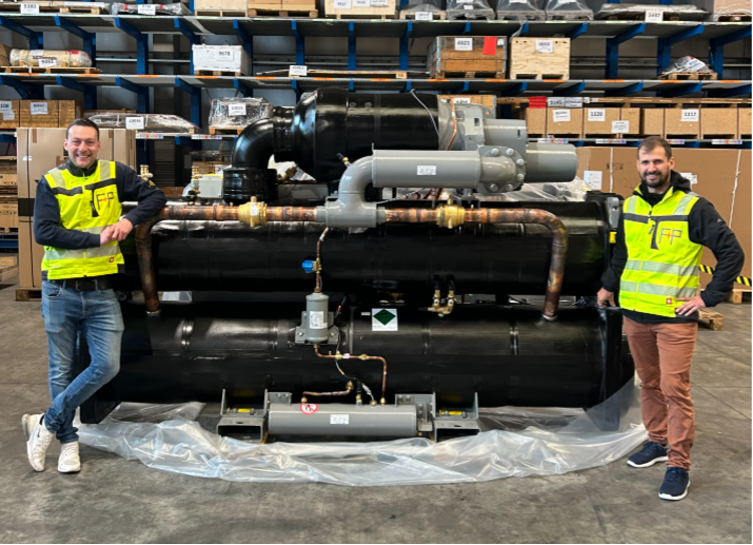 Large-scale heat pump for use at Digital Park Fechenheim | ||
 |
Our project at Digital Park Ostend
Our waste heat supply agreement with SAMSON AG is now in operation, delivering low-carbon thermal energy from its FRA14 data center to heat the neighboring Rolf Sandvoss Innovation Center (RSIC)—located directly across the street from the Digital Park Ostend campus. The facility went into operation as planned, turning what was once just an agreement into a working reality. The deal is a tangible example of how data centers can become active contributors to local sustainability goals—turning what was once considered a challenge due to operational impacts on a live data center into a genuine community asset.

Digital Realty and Samson AG Sign Agreement on Waste Heat Supply | ||
|
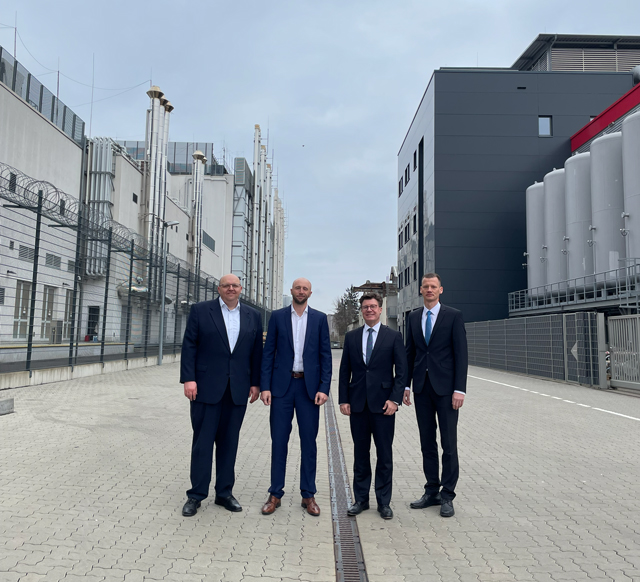
From data center to innovation center: How it works
The system works by drawing warm water directly from the return loop of the cooling ring and routing it via insulated pipelines to a high-temperature heat pump operated by SAMSON. The heat pump efficiently elevates the temperature to the 75°C required for SAMSON’s heating loop. This allows the RSIC to potentially reduce fossil fuel-based heating and carbon emissions by more than 80 tons per year now that the system is in operation. The project benefits from funding at both the federal and state level and is governed by a 15-year supply contract between ourselves and SAMSON AG.
A partnership built on proximity
The proximity of the two sites is central to the project’s efficiency. Sourcing thermal energy locally eliminates the additional energy losses that come with long-distance heat transport, delivering a stronger sustainability outcome for both parties.
“We are very pleased to have found a partner in SAMSON right on our doorstep for the sustainable and environmentally responsible use of waste heat,” said Volker Ludwig, our Senior Vice President and Managing Director Central Europe. “This new waste heat utilization system is expected to enable low-carbon heating for our neighbor SAMSON and make an important contribution to the City of Frankfurt’s environmental initiatives. Waste heat projects like this help us improve our energy efficiency and offer our customers an even more sustainable home for their innovative data and artificial intelligence (AI) solutions. Globally, Digital Realty already supports more than ten district heating networks with waste heat from our data centers, promoting sustainable urban energy solutions.”
For SAMSON, the agreement aligns directly with the company’s broader sustainability strategy. “By using sustainably sourced warm water, we are significantly reducing our consumption of fossil fuels and, with it, our CO₂ emissions,” said Dr. Dominic Deller, Chief Financial Officer of SAMSON AG. “Sustainability is a core component of our corporate strategy. With MainChange, we are building a state-of-the-art factory in Offenbach to the highest environmental standards—so it is only logical to also supply the building that will remain in Frankfurt in an energy-efficient way. We are particularly pleased that we found a partner in Digital Realty from our immediate neighborhood. The local sourcing of warm water avoids unnecessary additional energy expenditure and increases efficiency—for an even greater sustainability impact.”
From bachelor’s thesis to real-world impact
What makes this project particularly compelling is its origin story. The concept of using waste heat from our data center to supply the RSIC was first developed as part of a bachelor’s thesis in a dual-study mechanical engineering program, with a specialization in energy and drive technology, at SAMSON.
In 2023, we developed, with SAMSON and a student of Mechanical Engineering and Energy Technology, the technical solution for sustainable heat recovery using a high-temperature heat pump. The calculations confirmed the technical feasibility, economic efficiency, and environmental benefits of the approach—laying the foundation for the partnership.
It is a reminder that the solutions driving the energy transition often emerge from the ground up—from engineers willing to ask: what if this by-product could become someone else’s resource?
Project milestones
The facility at Digital Park Ostend went into operation as planned. Construction began in May 2026, with the team having already completed the first milestones: connection to the data center, installation of the heat exchanger and pump group, and the pipework along the building facade. Initial commissioning took place as scheduled in September 2026, followed by final adjustments and documentation through to the end of the year.
- August–December 2025: Project planning
- December 2025–March 2026: Tendering and contractor award
- May 2026: Construction begins
- June 2026: Facade and rooftop pipework completed
- July–September 2026: Civil engineering works
- August–September 2026: Planned cabling and fine assembly
- September 2026: System filling, commissioning, and test operation completed — the facility went into operation as planned
- October–December 2026: Fine-tuning and documentation
Scaling the model
These projects in Frankfurt are examples of a broader commitment. We support more than ten district heating networks around the world, channeling waste heat from data centers into urban energy systems. As cities intensify their focus on decarbonization, the data center industry has a clear role to play—not just in working towards minimizing its own footprint, but in actively contributing thermal energy that would otherwise go to waste.
The FRA14 project demonstrates what becomes possible when neighbors talk to each other, when a student’s technical insight finds a real-world application, and when a long-term partnership is built on shared sustainability goals. In Frankfurt’s Ostend district, Digital Realty and SAMSON AG are writing the future of urban energy together—one heat pump at a time.
Want to see how we can help power your operations more sustainably?
Visit our Sustainability Hub or connect with our team to explore how we can build a greener digital future together.